
Discover how worship and sacrifices are practiced among the Bamiléké of Cameroon. This article explores the flexibility of worship, the role of the Nkamsi, and the ecological and spiritual meaning of sacrifices.
God among the Bamiléké: Flexibility of Worship and Sacrifices
One may rightly ask: if the relationship with God is so flexible among the Bamiléké, what then of worship and sacrifices?
From what I observed while growing up in Bandjoun, my native village, there was no obligation to perform worship or sacrifices. Each person engaged in these practices according to their means and their needs.
Let us begin with worship. Among the Bamiléké, there are various forbidden days within the eight‑day calendar. Some of these days are more suitable for offering worship to God or for honoring the ancestors. But each person uses these days according to their personal needs. There are no bells calling people to gather. Those who wish to offer worship make arrangements with a person dedicated to God to do so at whatever time they choose, in whatever sacred space they prefer. They also invite whomever they wish.
In Ghomala’, the person dedicated to God is called “Nkamsi.” The same term is used for both men and women who serve in this role. Catholics chose to use this name to refer to the priest. However, in the ecclesial context, the term Nkamsi designates only men, not women. Indeed, in the Roman Catholic Church, only men may be ordained priests; women do not yet have access to this ministry.
In other Christian churches and among Muslims, the term Nkamsi is not used to designate the person devoted to God. These religious groups use other expressions, such as “Pasto” or “Ma’lam,” generally borrowed from outside.
Another important topic concerns the offerings for worship—what we call here sacrifices.
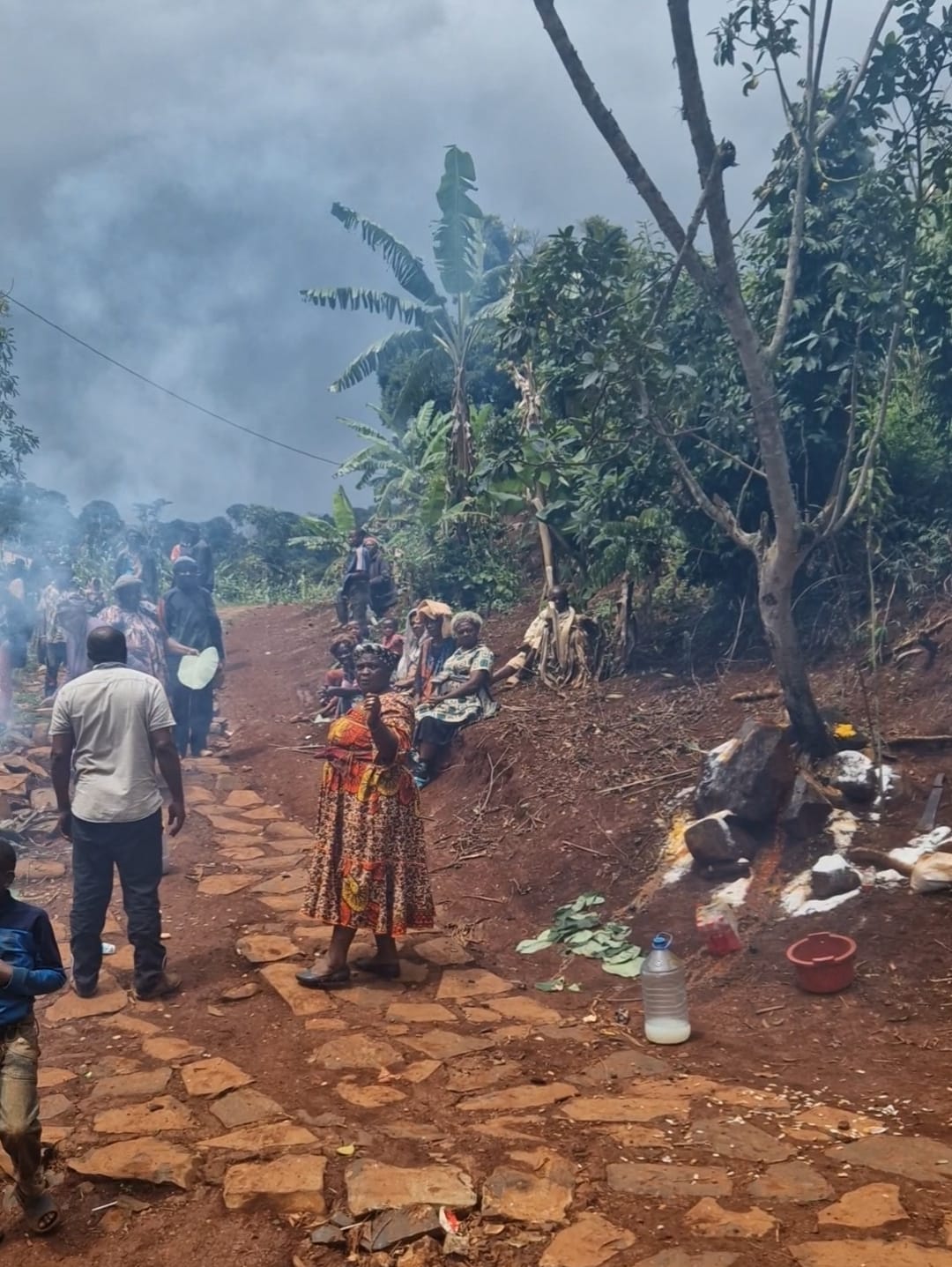
To offer a sacrifice, each person brings whatever they wish, in whatever quantity and form they choose. Naturally, there are elements traditionally associated with certain types of sacrifices. For example, the village hen, a goat for major sacrifices, jujube, salt, and corn flour used to prepare a dish with palm oil. These are the recurring items commonly found in various sacrifices.
But over time, other food items have been added, reflecting what people now eat. Essentially, anything that humans can consume may also be offered as a sacrifice to God.
A very important aspect of sacrifice among the Bamiléké is that the offering given to God is eaten by humans, animals, and insects. This detail is crucial: it means that when a sacrifice is offered, everyone who passes by the site receives food from the sacrifice. And the more people that pass by, the more the person offering the sacrifice feels blessed by God.
If few people pass, the person may doubt the blessing to come. Worse still, if nobody passes and the food remains untouched for days, the one who offered it will understand that the sacrifice has not been accepted by God. In that case, they must seek the cause of the blockage and offer an atonement sacrifice.
To say that a sacrifice has worked well, it is expected that larger animals—dogs, cats, and others—come to eat the bigger pieces of meat, while birds, ants, and other insects consume the corn flour, oil, and salt left as offerings.
Reflecting on this worldview, I have come to understand that sacrifice among the Bamiléké is an act of union with God that necessarily expresses itself through connection: connection between humans, connection with animals, with insects, with plants, with water, the earth, and the stones.
This means that sacrifice among the Bamiléké is, ultimately, both a spiritual and ecological practice: God “eats” when humans, animals, insects, water, earth, and rocks “eat”—without exclusion.
How are religious rites and offerings to God practiced in your culture? I would love to read your comment.
A genuine relationship with God is that which brings unity and not division!