

A powerful account of the Maasai ritual of slaughtering a sheep—an initiation into mastery, shared responsibility, cultural codes, and the art of communal harmony.
My Maasai Initiation: Step 4 – The Slaughter of the Sheep
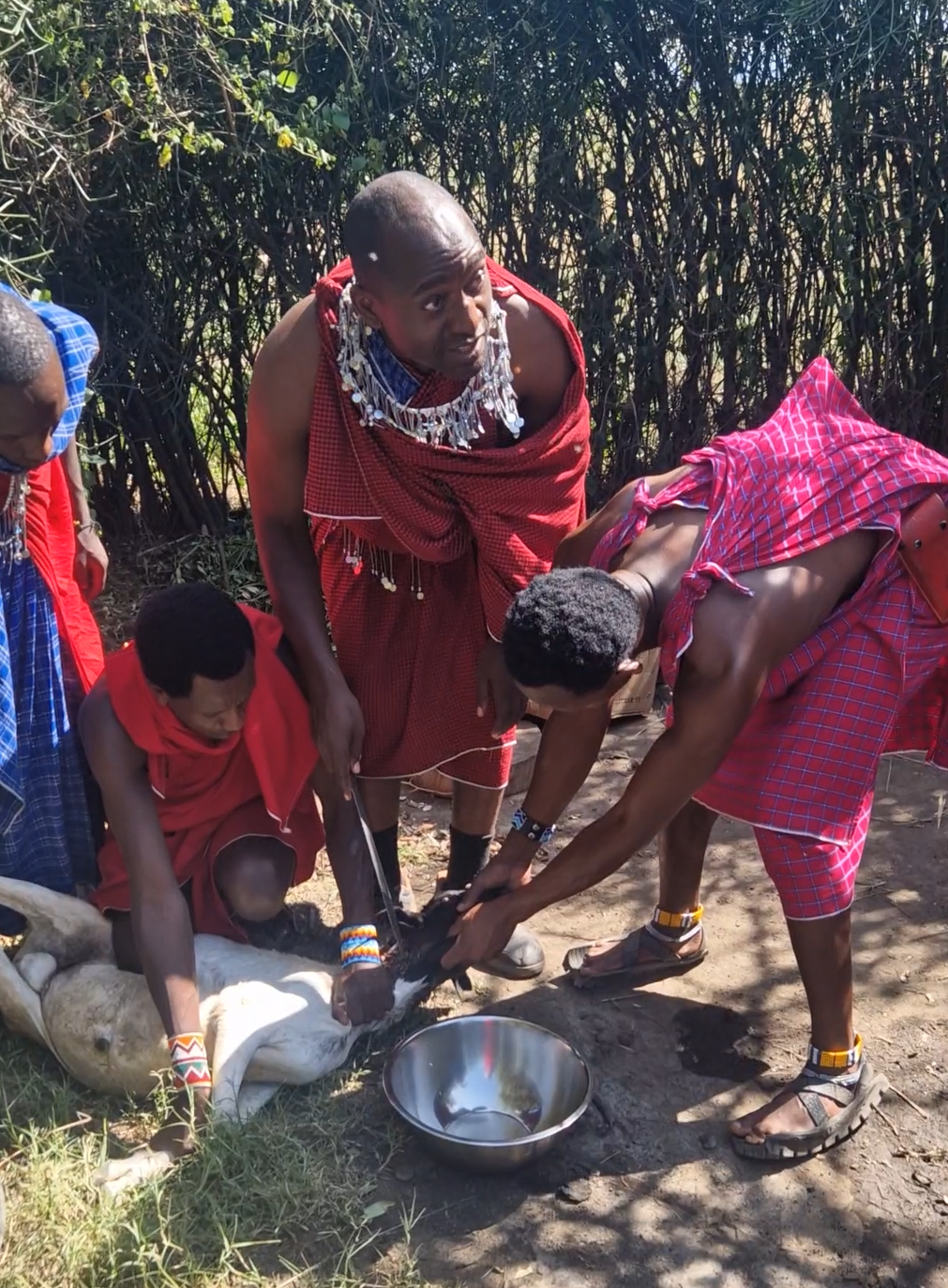
One of the most unforgettable moments of my initiation day was the slaughter of the sheep. In the afternoon, at the exact time determined by the wisdom of the elders, we went to the designated place to slaughter the sheep the Maasai way.
I received clear instructions on how to hold the knife and perform the gestures required. Three other Maasai herders held the sheep firmly. The blood was collected in a dish. The sheep was immediately skinned; we ate the kidneys right away and roasted the liver before eating it.
Everyone Knows What Must Be Done
I must admit that I hesitated when the time came to take the knife and cut the sheep’s throat. My Maasai friends encouraged me, reminding me that I was the one being honored that day. The sheep itself was so calm that one could almost think it was willingly participating in the experience.
Once the sheep was killed, those responsible for removing the skin immediately took their well‑sharpened knives and removed it with such ease that it looked as if they were simply undressing the animal.
Then came those in charge of cutting it up. I noticed how well they knew the anatomy of the sheep. They did not need to break any bones. It was as if the sheep’s joints were simply placed one on top of the other, and all they had to do was slide the knife to retrieve the different parts.
Meanwhile, on the other side, those tasked with cleaning the intestines were already at work. They knew exactly what needed to be cooked right away and what had to be set aside for the evening soup. I witnessed an exceptional distribution of tasks.
Everyone Knows What They Should Receive
My guide explained to me that this practice—seemingly routine—is the expression of an entire vision of society: everyone knows what they will do, and everyone knows what part belongs to whom.
This is when I understood that slaughtering a sheep is not merely cutting it into pieces. It is an act of sharing that expresses the social cohesion of the clan.
Each part of the animal is reserved for a specific group within the community: one part for the elders, another for the women, another for the children, and another for the brave young men known as warriors.
What impressed me most was that the distribution was not guided by power or domination. The logic was protection, respect, and social harmony.
For example, my guide explained that the portion reserved for the elders contains no bones, because the elders often have dental difficulties.
A Lesson in Social Cohesion
This experience of slaughtering the sheep helped me understand how everyday activities can become powerful elements of social cohesion through teamwork and respect for cultural codes.
And you—do you have specific ways of slaughtering animals in your culture? Share your story in the comments.
#CulturalIntelligence #IndigenousKnowledge #LeadershipInsights #MaasaiCommunity #SocialCohesion #TraditionalPractices #AnthropologicalPerspectives #Afrijohn #CulturalInsights #JeanDeDieuTagne


I once witnessed the slaughtering of a goat by my tunisian friend. She used a remarkable technique where she cut a tiny hole in the animal’s skin and then inserted a hollow stick and blew in it. The goat blew up like a balloon and the skin detached from the flesh. She then skinned the animal took apart the whole goat with a tiny sharp hand knife. It was very impressive!
May you tell your friend that such knowledge belong, in my way of seeing, to the patromony of humanity? It should therefore be preserved and shared.